
Thermal Physics
Temperature
Thermal equilibrium describes the equal transfer of thermal energy in and out of a system.
The absolute scale of temperature is Kelvin. You convert from Celsius to Kelvin by adding 273 to the Celsius number. This is because -273 Celsius (0K) is absolute zero, which is the theoretical lowest possible temperature at which particles have an internal energy of 0J, causing zero movement and zero pressure.
Solids, Liquids, and Gases
| Property | Solid | Liquid | Gas |
| Shape | Definite shape. | Indefinite shape (depends on container). | Indefinite shape (depends on container). |
| Volume | Definite volume. | Definite volume. | Indefinite volume (depends on container). |
| Particle arrangement | Particles are fixed close together in a regular lattice. (Edge case exceptions like glass, where they are arranged in an irregular lattice.) | Particles are close together, but not in a regular lattice - rather, in a random arrangement. | Particles are very far apart in a random arrangement. |
| Particle movement | Particles vibrate in place. | Particles are constantly moving close to each other, flowing over other particles. | Particles are constantly moving in straight lines in directions influenced by collisions with other particles. |
| Intermolecular forces | Strong. | Moderate. | Weak, often negligible. |
| Compressibility | Almost incompressible. | Almost incompressible. | Highly compressible. |
| Fluidity | Cannot flow. | Flows easily. | Flows easily. |
| Density | Generally high. | Generally moderate. | Generally very low. |
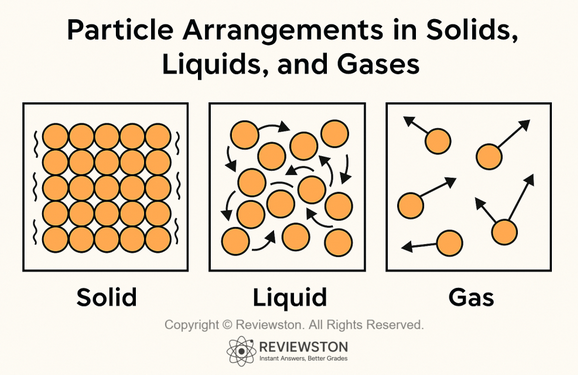
Internal energy is defined as the sum of the random distribution of kinetic and potential energies of all molecules in a system.
Potential energy is defined as the energy stored within a system due to the relative positions and intermolecular forces between molecules in a system.
When the temperature around a material increases, there is a positive temperature gradient, so thermal energy from the surroundings transfers to the kinetic energy stores of its particles, increasing its internal energy. This enables it to change state from solid to liquid (melting) to gas (evaporating).
Conversely, reduction of temperature causes a negative temperature gradient, so the opposite happens, causing a change in state from gas to liquid (condensing) to solid (freezing).
During a change in state, the temperature of the material remains constant, so kinetic energy doesn't change. However, due to the increased spacing between particles, potential energy becomes less negative, so internal energy increases regardless.
Specific Heat Capacity
Specific heat capacity is the amount of energy to increase the temperature of 1 unit mass of a substance by 1 unit of temperature. It is calculated with:

... where delta Q is the change in energy, m is the mass, c is the specific heat capacity, and delta T is the change in temperature.
Specific Latent Heat
Specific latent heat is the amount of energy required to change the state of 1 unit mass of a substance. It is calculated with:

... where Q is energy, m is mass, and L is specific latent heat.
Brownian Motion
Brownian motion describes the observed random motion of particles suspended in a fluid due to the bombardment of smaller particles.
Amount of Substance
The mole is a unit used to measure the amount of a substance. Each mole of a substance contains 6.02e+23 atoms. From this, mass and mass/mol can be calculated using the formula:

... where n is amount of substance, m is mass, and Mr is mass per unit amount.
The Kinetic Theory
The kinetic model of matter dictates the motion of particles in an ideal gas. Real gases behave similarly to an ideal gas in low pressures and high temperatures significantly above their boiling points. The behavior of an ideal gas has multiple assumptions:
- The gas contains a large number of molecules.
- Particles move randomly and rapidly.
- All collisions are perfectly elastic (kinetic energy is perfectly conserved).
- The forces between particles are negligible, apart from collisions. As such, the internal energy is equal to the random distribution of kinetic energies of all particles in the gas, as it is assumed that potential energy is negligible.
- The time for a collision to happen is negligible to the time between collisions.
- Particles have a negligible volume compared to the volume of the container they're in.
With all these assumptions, an equation can be made for an ideal gas in a container:

... where P is pressure, V is volume, n is amount of gas, R is the ideal gas constant, and T is temperature.
The root mean square speed of a gas, c_rms, is the square root of the mean of the squares of all velocities of particles in an ideal gas:

It is known that:

... where p is pressure, V is volume, N is the number of particles, m is mass of a particle, and c bar squared is the mean square speed.
Investigating Gases
Boyle's law states that the product of the pressure and volume of an ideal gas in a container is constant regardless of how pressure and volume are modified.

... where bases of 1 and 2 represent values of pressure and volume before and after modification of one of the variables.
The pressure-temperature law is similar, but states that the ratio of pressure to temperature is constant regardless of how pressure and temperature are modified.

On a graph of pressure against temperature, the x-intercept marks the value of absolute zero, as a temperature of 0K means that particles have no energy, so they don't move, so no pressure is exerted.
Charles' law is also similar, but relates to the ratio of volume to temperature:

Combining this gives:

... where PV/T is directly proportional to the amount of gas molecules n in the container of ideal gas. If you plot PV/T against n, you will obtain R - the ideal gas constant - from the gradient of the straight line through the origin.
The Boltzmann Constant
The Boltzmann constant k is a constant used when relating the temperature of a gas to the mean translational kinetic energy of particles in the gas.

You use PV = nRT when you're dealing with amount of substance, and you use PV = NkT when dealing with numbers of molecules.
No comments to display
No comments to display