
4.4 - Waves
Wave Motion
Waves transfer energy from one place to another without any net transfer of matter. These can be longitudinal or transverse:
| Longitudinal |
|
| Transverse |
|
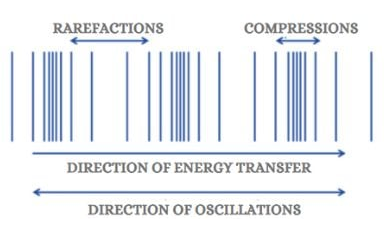
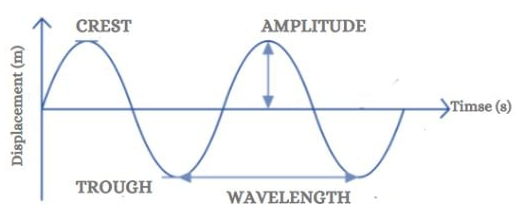
Waves that move away from a source are called progressive waves. However, this regards only the movement of energy - particles oscillate in place.
Wave Terminology
| Displacement | The distance traveled by a wave from its rest position. |
| Amplitude | The maximum displacement of oscillating particles in a wave. |
| Wavelength | The distance between two successive identical points of a wave. |
| Time period | The time taken for a wave to complete one pattern of oscillation. |
| Frequency | The number of oscillations at any point per unit time. Reciprocal of time period. |
| Phase difference | A measure of the difference in pattern of oscillation between two points of a wave. Measured in radians from 0 to 2pi. |
| Path difference | The difference between the distances traveled by two waves arriving at the same point. Usually measured in terms of wavelength, as path difference resets to 0m at a path difference equal to one wavelength. |
Oscilloscopes
An oscilloscope displays a voltage-time signal. It can be used to measure the output from a microphone or signal generator.
Each horizontal division represents a unit of time. The unit of time per division is determined with the time base - e.g. 0.002 s/div. This can help you determine time period.
Each vertical division represents a unit of voltage. The unit of voltage per division is determined with the sensitivity - e.g. 20 V/div (less sensitive) to 5 mV/div (far more sensitive). The more sensitive, the easier it is to determine the precise points where the wave crosses the axis, as the slope appears steeper and the peaks are more defined. However, it also increases the risk of the signal moving off-screen.
Wave Equations

... where v is wave velocity, f is wave frequency, and lambda is wave wavelength. For EM waves in a vacuum, v = 3.00e8. For sound waves, v = 330.

... where I is the wave intensity (Wm-2), P is the wave power, and A is the surface area of the source (e.g. 4r2 for a sphere like the Sun).
Wave intensity is defined as the rate at which energy is transferred from one location to another as the wave travels through space. It is proportional to the square of its amplitude - e.g. if the amplitude decreases by a factor of 2, intensity reduces by a factor of 22 = 4.
EM Spectrum
Waves in the EM spectrum are transverse waves that can travel through a vacuum. They all have a magnetic and an electrical wave interlocked and at right angles to each other. In a vacuum, they travel at c = 2.98e8 ms-1.
| Wave | Wavelength / m | Frequency / Hz |
| Radio | 1e-1 to 1e4 | 3e4 to 3e9 |
| Microwave | 1e-4 to 1e-1 | 3e9 to 3e12 |
| Infrared | 7.4e-7 to 1e-3 | 3e11 to 4e14 |
| Visible light | 3.7e-7 to 7.4e-7 | 4e14 to 8e14 |
| Ultra violet | 1e-9 to 3.7e-7 | 8e14 to 3e17 |
| X-Rays | 1e-12 to 1e-7 | 3e15 to 3e20 |
| Gamma rays | 1e-16 to 1e-9 | 3e17 to 3e24 |
Ionising EM radiation has photons with sufficient energy to knock electrons from the shells of atoms.
99% of UV radiation is classified as UV-A, which is non-ionising. UV-B and UV-C are ionising, but UV-C is filtered out by the Earth's atmosphere, and the ionising nature of UV-B is mitigated using sunscreen creams.
Properties of Waves
| Reflection | When a wave bounces off a surface. |
| Refraction | When a wave moves from one material into another of a different density, causing the wave to change speed and bend (unless traveling along the normal). Can be seen in glasses. |
| Diffraction | When a wave passes through an aperture that has a separation similar to the wave's wavelength, causing it to change direction. |
| Interference | When two or more waves overlap at a point, which has a particle displacement equal to the algebraic sum of all of the involved waves' displacements. |
Light Refraction
Refraction occurs when a wave moves from one material into another of a different density, causing the wave to change speed and bend (unless traveling along the normal).
Every material has a refractive index. The higher this index, the stronger the effect of refraction. The refractive index is given as:

... where v is the speed of the wave in the medium.
Snell's Law
The refractive index also determines the angle at which a wave refracts, given by:

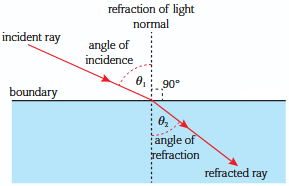
Total internal reflection
This occurs when the angle of refraction (theta 2) is greater than or equal to 90 degrees. The incident angle causing a refracted angle of 90 degrees is known as the critical angle - any incident angle greater than this causes TIR. Take air and water for an example:
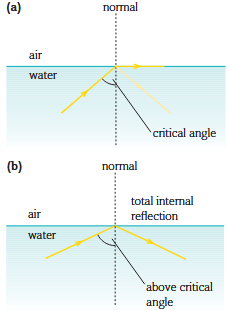
The critical angle is determined using:

Polarisation
Serves as good evidence for the wave nature of light (on the particle nature, look at 4.5 - Quantum Physics). All transverse waves can be polarised.
Light emitted from a source is unpolarised by default - the electric field of EM waves can be in any number of planes. Some crystalline materials can cause the oscillating fields to happen in only one plane. A wave with fields only one plane is known as plane polarised.
Malus' Law
When a perfect polarising filter is put in front of a polarising wave with the vertical at an angle theta to the plane, the intensity of the output is:

Interference and Superposition
The principle of superposition states that when two or more waves of the same type meet, the resultant wave can be found by adding the displacements of the individual waves.
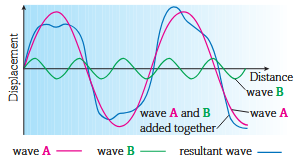
Coherent waves have a constant frequency, and thus a constant phase difference.
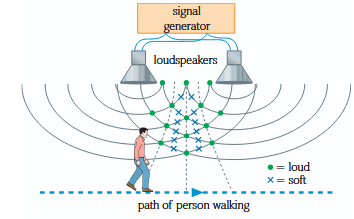
With two waves in phase (path difference a multiple of lambda; phase difference 0 or a multiple of 2pi), total constructive interference occurs. This means the resultant wave has an increased amplitude.
With two waves out of phase (path difference an odd multiple of 1/2 lambda; phase difference an odd multiple of pi), total destructive interference occurs. This means the resultant wave has an amplitude of 0m.
In sound/spreading waves instead of waves in a linear path:
Young's Double-Slit Experiment
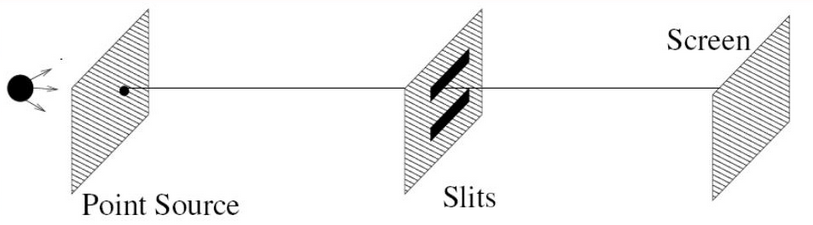
Involves the emission of monochromatic light waves with wavelength lambda leaving a source and entering two slits with separation "a", causing diffraction. The diffracted waves travel a perpendicular distance "D" from the slits and superpose, constructively and destructively interfering to form fringes with separation "x" between maxima:

Diffraction gratings
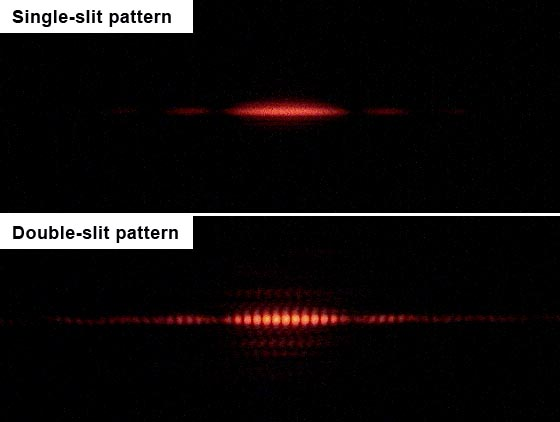
A diffraction grating is a piece of optical equipment made from glass, onto which hundreds/thousands of very thin, parallel, and equally spaced grooves have been accurately engraved. Measured in lines per mm. This greatly increases the resolution of interference patterns, which increases with number of slits. As you can see in the above image, a double slit pattern has much clearer fringe separations than the single slit pattern. Different orders of fringe are visible at path differences equal to multiples of lambda depending on slit separation, which define where fringes are visible - e.g.:
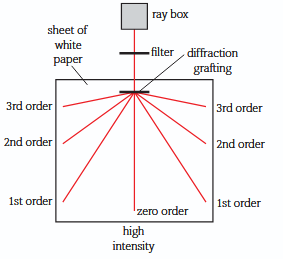

... where n is the order of the maximum (1, 2, 3), lambda is the wavelength of light, d is slit separation, and theta is the angle between the beam and the grating.
Stationary Waves
Stationary waves are produced by interference in accordance with the principle of superposition. Two waves must be coherent, have roughly the same amplitude, and be traveling in opposite directions. Nodes are points of zero amplitude, where waves undergo destructive interference. Antinodes are points of maximum amplitude, where waves undergo constructive interference. Adjacent nodes and adjacent antinodes have a separation equal to half the wavelength.
Harmonics
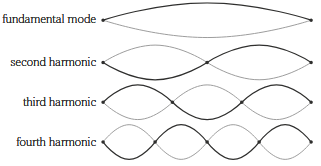
Depending on the frequency of the stationary wave, it may have a different mode of harmonic:
Longitudinal Waves
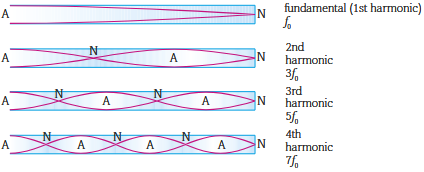
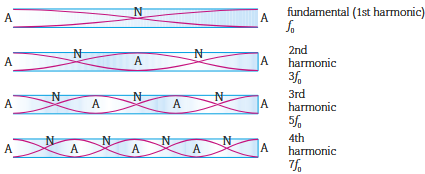
In tubes, there is always a node at the closed end, and an antinode at an open end. This makes the fundamental and nth harmonics look different:
No comments to display
No comments to display