
Thermal Physics
Temperature
Thermal equilibrium describes the equal transfer of thermal energy in and out of a system.
The absolute scale of temperature is Kelvin. You convert from Celsius to Kelvin by adding 273 to the Celsius number. This is because -273 Celsius (0K) is absolute zero, which is the theoretical lowest possible temperature at which particles have an internal energy of 0J, causing zero movement and zero pressure.
Solids, Liquids, and Gases
| Property | Solid | Liquid | Gas |
| Shape | Definite shape. | Indefinite shape (depends on container). | Indefinite shape (depends on container). |
| Volume | Definite volume. | Definite volume. | Indefinite volume (depends on container). |
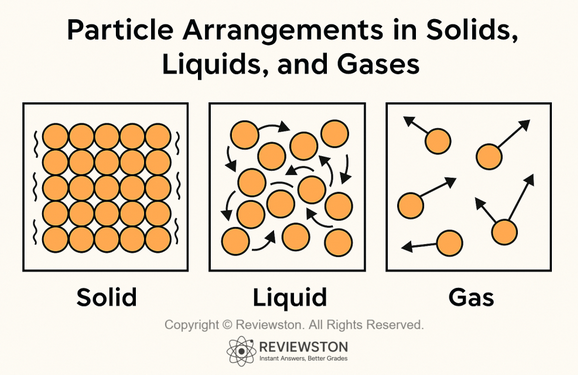
| Particle arrangement | Particles are fixed close together in a regular lattice. (Edge case exceptions like glass, where they are arranged in an irregular lattice.) | Particles are close together, but not in a regular lattice - rather, in a random arrangement. | Particles are very far apart in a random arrangement. |
| Particle movement | Particles vibrate in place. | Particles are constantly moving close to each other, flowing over other particles. | Particles are constantly moving in straight lines in directions influenced by collisions with other particles. |
| Intermolecular forces | Strong. | Moderate. | Weak, often negligible. |
| Compressibility | Almost incompressible. | Almost incompressible. | Highly compressible. |
| Fluidity | Cannot flow. | Flows easily. | Flows easily. |
| Density | Generally high. | Generally moderate. | Generally very low. |
WhenInternal heatenergy is supplieddefined as the sum of the random distribution of kinetic and potential energies of all molecules in a system.
Potential energy is defined as the energy stored within a system due to the relative positions and intermolecular forces between molecules in a material,system.
When the temperature around a material increases, there is a positive temperature gradient, so thermal energy from the surroundings transfers to the kinetic energy stores of its particlesparticles, increasing its internal energy. This enables it to change state from solid to liquid (melting) to gas (evaporating).
Internal
Conversely, Energyreduction of temperature causes a negative temperature gradient, so the opposite happens, causing a change in state from gas to liquid (condensing) to solid (freezing).
During a change in state, the temperature of the material remains constant, so kinetic energy doesn't change. However, due to the increased spacing between particles, potential energy becomes less negative, so internal energy increases regardless.
Brownian Motion
Brownian motion describes the observed random motion of particles suspended in a fluid due to the bombardment of smaller particles.