
Thermal Physics
Temperature
Thermal equilibrium describes the equal transfer of thermal energy in and out of a system.
The absolute scale of temperature is Kelvin. You convert from Celsius to Kelvin by adding 273 to the Celsius number. This is because -273 Celsius (0K) is absolute zero, which is the theoretical lowest possible temperature at which particles have an internal energy of 0J, causing zero movement and zero pressure.
Solids, Liquids, and Gases
Shape
Definite shape.
Indefinite shape (depends on container).
Indefinite shape (depends on container).
Volume
Definite volume.
Definite volume.
Indefinite volume (depends on container).
Particle arrangement
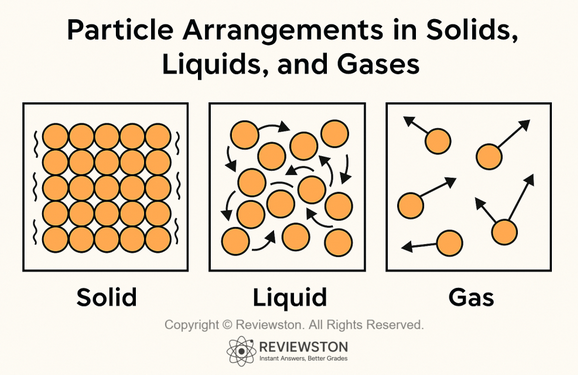
Particles are fixed close together in a regular lattice. (Edge case exceptions like glass, where they are arranged in an irregular lattice.)
Particles are close together, but not in a regular lattice - rather, in a random arrangement.
Particles are very far apart in a random arrangement.
Particle movement
Particles vibrate in place.
Particles are constantly moving close to each other, flowing over other particles.
Particles are constantly moving in straight lines in directions influenced by collisions with other particles.
Intermolecular forces
Strong.
Moderate.
Weak, often negligible.
Compressibility
Almost incompressible.
Almost incompressible.
Highly compressible.
Fluidity
Cannot flow.
Flows easily.
Flows easily.
Density
Generally high.
Generally moderate.
Generally very
low.
When heat is supplied to a material, heat energy transfers to the kinetic energy stores of its particles