
6.1 - Capacitors
Core Info and Definitions
A capacitor is a circuit component that stores charge in a circuit by separating equal and opposite charges onto two electrical conductors (plates) with an insulator in between them.
Capacitance, C, defines the quantity of charge Q which can be stored per unit potential difference across the plates. Measured in farads.

Capacitance
Total Circuit Capacitance
In series, capacitance sum is determined in a similar way to how resistance is determined with resistors in parallel:

In parallel, it's the opposite - the capacitances are just added to each other:

Capacitor Energy
Capacitor energy can be given as:

... and you can use C=Q/V to substitute values in to determine energy with charge.
Charging and Discharging
Where x0 is the initial value of the variable, C is capacitance, R is resistance and t is elapsed time:
Current
Charge
PD
Charging





(... yes, current has the same equation for charging and discharging.)
The time taken for the charge of the capacitor to fall to 1/e (~37%) of its original charge is known as the time constant.

Graphical Methods
Take V in discharging for an example. You can apply the natural logarithm "ln" to both sides to separate variables and obtain a straight line in a graph:

In here, the y-intercept is "ln(V0)" and the gradient is "-1/CR". You can use the gradient to find the capacitance of the circuit, and you can use the y-intercept to find the initial pd of the capacitor by raising e to the power of "ln(V0)".
Spreadsheet Modelling
You can model the discharge of a capacitor using a spreadsheet method without using experimental data. This is known as iterative modelling. You can do this with the following equation:

This gives the decrease of charge, so the output of this should be subtracted from the last value of charge. The table looks like this1:
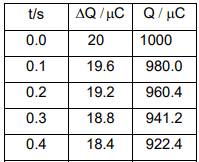
... with a time increment of +0.1.