
4.4 - Waves
Wave Motion
Waves transfer energy from one place to another without any net transfer of matter. These can be longitudinal or transverse:
| Longitudinal |
|
| Transverse |
|
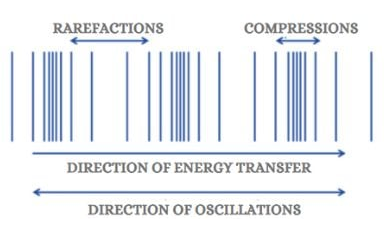
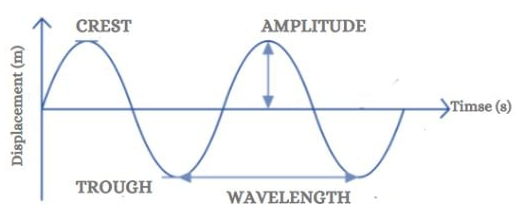
Waves that move away from a source are called progressive waves. However, this regards only the movement of energy - particles oscillate in place.
Wave Terminology
| Displacement | The distance traveled by a wave from its rest position. |
| Amplitude | The maximum displacement of oscillating particles in a wave. |
| Wavelength | The distance between two successive identical points of a wave. |
| Time period | The time taken for a wave to complete one pattern of oscillation. |
| Frequency | The number of oscillations at any point per unit time. Reciprocal of time period. |
| Phase difference | A measure of the difference in pattern of oscillation between two points of a wave. Measured in radians from 0 to 2pi. |
Oscilloscopes
An oscilloscope displays a voltage-time signal. It can be used to measure the output from a microphone or signal generator.
Each horizontal division represents a unit of time. The unit of time per division is determined with the time base - e.g. 0.002 s/div. This can help you determine time period.
Each vertical division represents a unit of voltage. The unit of voltage per division is determined with the sensitivity - e.g. 20 V/div (less sensitive) to 5 mV/div (far more sensitive). The more sensitive, the easier it is to determine the precise points where the wave crosses the axis, as the slope appears steeper and the peaks are more defined. However, it also increases the risk of the signal moving off-screen.
Wave Equations

... where v is wave velocity, f is wave frequency, and lambda is wave wavelength. For EM waves in a vacuum, v = 3.00e8. For sound waves, v = 330.

... where I is the wave intensity (Wm-2), P is the wave power, and A is the surface area of the source (e.g. 4r2 for a sphere like the Sun).
Wave intensity is defined as the rate at which energy is transferred from one location to another as the wave travels through space. It is proportional to the square of its amplitude - e.g. if the amplitude decreases by a factor of 2, intensity reduces by a factor of 22 = 4.
Properties of Waves
Light Refraction
Refraction occurs when a wave moves from one material into another of a different density, causing the wave to change speed and bend (unless traveling along the normal).
Every material has a refractive index. The higher this index, the stronger the effect of refraction. The refractive index is given as:

... where v is the speed of the wave in the medium.
Snell's Law
The refractive index also determines the angle at which a wave refracts, given by:

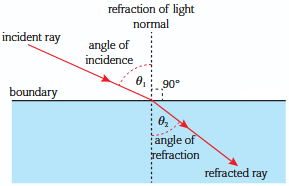
Total internal reflection
This occurs when the angle of refraction (theta 2) is greater than or equal to 90 degrees. The incident angle causing a refracted angle of 90 degrees is known as the critical angle - any incident angle greater than this causes TIR. Take air and water for an example:
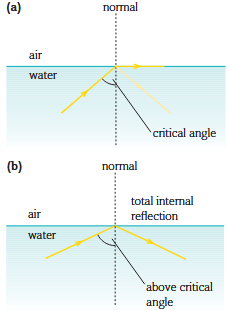
The critical angle is determined using:

Polarisation
Serves as good evidence for the wave nature of light (on the particle nature, look at 4.5 - Quantum Physics). All transverse waves can be polarised.
Light emitted from a source is unpolarised by default - the electric field of EM waves can be in any number of planes. Some crystalline materials can cause the oscillating fields to happen in only one plane. A wave with fields only one plane is known as plane polarised.
Malus' Law
When a perfect polarising filter is put in front of a polarising wave with the vertical at an angle theta to the plane, the intensity of the output is:

EM Spectrum
Waves in the EM spectrum are transverse waves that can travel through a vacuum. They all have a magnetic and an electrical wave interlocked and at right angles to each other. In a vacuum, they travel at c = 2.98e8 ms-1.
Ionising EM radiation has photons with sufficient energy to knock electrons from the shells of atoms.
99% of UV radiation is classified as UV-A, which is non-ionising. UV-B and UV-C are ionising, but UV-C is filtered out by the Earth's atmosphere, and the ionising nature of UV-B is mitigated using sunscreen creams.