
4.4 - Waves
Wave Motion
Waves transfer energy from one place to another without any net transfer of matter. These can be longitudinal or transverse:
| Longitudinal |
|
| Transverse |
|
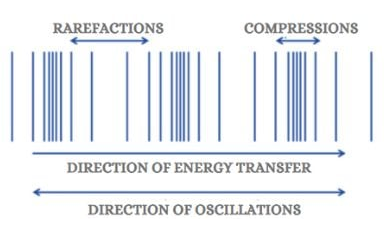
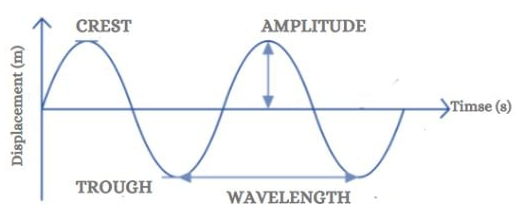
Waves that move away from a source are called progressive waves. However, this regards only the movement of energy - particles oscillate in place.
Wave Terminology
| Displacement | The distance traveled by a wave from its rest position. |
| Amplitude | The maximum displacement of oscillating particles in a wave. |
| Wavelength | The distance between two successive identical points of a wave. |
| Time period | The time taken for a wave to complete one pattern of oscillation. |
| Frequency | The number of oscillations at any point per unit time. Reciprocal of time period. |
| Phase difference | A measure of the difference in pattern of oscillation between two points of a wave. Measured in radians from 0 to 2pi. |
Oscilloscopes
An oscilloscope displays a voltage-time signal. It can be used to measure the output from a microphone or signal generator.
Each horizontal division represents a unit of time. The unit of time per division is determined with the time base - e.g. 0.002 s/div. This can help you determine time period.
Each vertical division represents a unit of voltage. The unit of voltage per division is determined with the sensitivity - e.g. 20 V/div (less sensitive) to 5 mV/div (far more sensitive). The more sensitive, the easier it is to determine the precise points where the wave crosses the axis, as the slope appears steeper and the peaks are more defined. However, it also increases the risk of the signal moving off-screen.
Wave Equations

... where v is wave velocity, f is wave frequency, and lambda is wave wavelength. For EM waves in a vacuum, v = 3.00e8. For sound waves, v = 330.

... where I is the wave intensity (Wm-2), P is the wave power, and A is the surface area of the source (e.g. 4r2 for a sphere like the Sun).
Wave intensity is defined as the rate at which energy is transferred from one location to another as the wave travels through space. It is proportional to the square of its amplitude - e.g. if the amplitude decreases by a factor of 2, intensity reduces by a factor of 22 = 4.
Properties of Waves