
Cosmology
Structure of the Universe
Galaxies are clusters of millions and billions of stars. They are constantly moving due to the expansion of the universe. The further they are - i.e. closer to the edge of the universe - the faster they move.
Stars are spheres of interstellar matter that undergo nuclear fusion.
Planets are bodies that move in elliptical orbits around a star to form a solar system. They are less dense than stars.
Planetary satellites are bodies that move in elliptical orbits around a planet. An example is the moon of Earth.
Star formation and life cycle
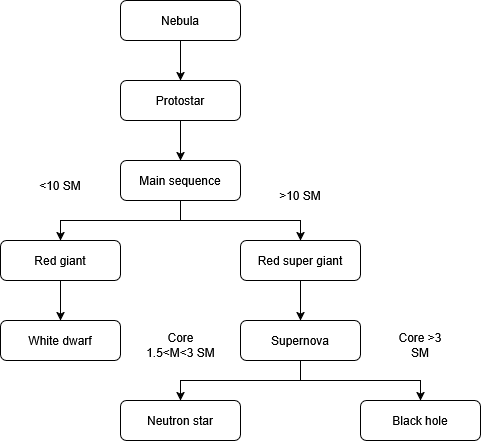
Nebula and Protostar
A nebula is a cloud of interstellar matter composed of various elements such as hydrogen and helium. They exert gravitational force on each other, causing a dense sphere to be created from gathered matter.
This sphere is a protostar. A protostar is a small, dense sphere of interstellar matter that does not yet undergo nuclear fusion. As it gets larger, temperature and pressure increases, enabling nuclear fusion to begin. This transitions to the next phase: main sequence.
Main Sequence Star
A main sequence star is a sphere of interstellar matter that undergoes nuclear fusion. It is of a temperature where it primarily fuses hydrogen nuclei (protons) into helium nuclei.
When hydrogen runs out, the star transitions to the next phase: red (super) giant.
Red Giant
A red giant is a sphere of interstellar matter that undergoes nuclear fusion of larger elements like helium, all the way up to, and excluding, iron. This occurs due to gravitational collapse after main sequence - hydrogen is no longer being fused, so the outward pressure caused by fusion decreases, causing the star to succumb to gravitational pressure. At a low volume, the massive density causes temperature and pressure to increase to the point where nuclear fusion of these larger elements can occur.
If the main sequence star after all fuel consumption is less than 10 solar masses, it transitions into a red giant. If greater, it transitions into a red super giant (a larger red giant).
After these elements run out again, the star transitions into the next stage depending on the mass of the core of what is left.
White Dwarf
A red giant will always transition into a white dwarf. The Chandrasekhar limit states that the maximum mass for a white dwarf is 1.44 solar masses.
Supernova
The outer layers of the super red giant collapse into the core and bounce off, resulting in a blast that sends the material of these outer layers into space. The scattered material can form part of nebulae, being part of the birth of a new star.
What happens next depends on the mass of the remaining core of the super red giant.
Neutron Star
If the mass of the core is between 1.5 and 3 solar masses, it collapses into a neutron star. This is due to the gravitational pressure bringing atoms closer together, to the point where electrons collide with protons to form neutrons.
Black Hole
If the mass of the core is greater than 3 solar masses, it continues collapsing into itself, creating a black hole. This has a gravitational force so strong, even light cannot escape it.
EM radiation from stars
Electrons occupy certain orbits in atoms, and these orbits are associated with definite energies and are known as energy levels. When electrons gain energy, they move up a level. When they go down a level, lost energy is emitted as a photon with an energy equal to the difference in energy of the energy levels. The frequency of this photon is dictated by E=hf.
- Emission line spectra are produced in cooling hot gas of an element, when an excited electron moves down an energy level and emits a photon. The energies and frequencies of these photons, along with abundances, are plotted on a spectrum in lines on a dark background. The spacing between these lines is proportional to the spacing between energy levels. Since the spacing of energy levels is unique to each element, each element has its own emission spectrum.
- Absorption line spectra are produced in firing EM radiation into cold gas of an element, when photons of certain energies are absorbed by atoms of this element, causing electrons to move up an energy level. Thus, these absorbed photons do not pass through. Instead of a black background, this is presented as black lines on a rainbow background where photons of that frequency (as per E=hf) have been absorbed.
Outputs of the above two methods are passed through a diffraction grating to display the spectrum on a screen. The wavelength of the light source can be calculated using:

... where n is the order of the maximum, lambda is the wavelength, d is the distance between diffraction grating lines, and theta is the angle between the output beam and the grating.
Wien's law
Stefan's law
Astronomical distances
The astronomical unit (AU) is the distance between the centre of the Earth and the centre of the Sun.
One light year is the amount of distance travelled by light in one year. About 9.5e+15m.
One parsec is the distance of a star from Earth when the angle of parallax subtended by the radius of the Earth's orbit is 1 arc second (1/3600th of a degree). This is about 3.1e+16m.
Stellar parallax is the apparent shifting in position of a star viewed in a background of distant stars when viewed from different positions on the Earth
[Diagram of parallax setup to view a star]
Scientists take an image of the star from one observation point in January, then another 6 months later in June. Since 6 months pass, the Earth travelled 2AU about the sun. This is a base of a triangle used in this calculation. The angle 2p is determined with telescopic imaging. This is divided by 2 to get an angle p. This is used in the equation:

... where d is distance to the star in parsecs.
The Doppler effect
The Doppler effect is the apparent change in wavelength caused by the relative motion between the wave source and an observer.
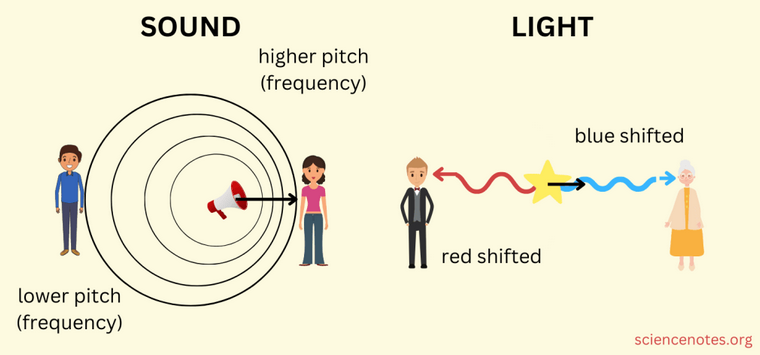
When the moving object moves towards the object, the observed frequency is greater. When away, it's observed as lower.

... where v is the velocity of the galaxy relative to Earth. For distances from galaxies, the difference in wavelength/frequency is taken between the known hydrogen line spectrum and that of the observed galaxies.
The Doppler effect was observed by Edwin Hubble in 1929. He noticed the differences in hydrogen line spectra from different galaxies compared to the known hydrogen line spectrum and concluded that galaxies are constantly moving - not only that, but the largest majority of them are moving away from us. He also noticed that galaxies further from us moved faster than those closer to us. This is expressed in his equation:

... where v is velocity, D is distance to a galaxy, and H_0 is Hubble's constant, which is estimated to be 2.27e-18 s^{-1}. The reciprocal of Hubble's constant corresponds to the age of the universe.
The observation evidences the universe's expansion - specifically, the expansion of space between galaxies. Like drawing dots on a deflated balloon and inflating it: the space between dots expands, but the dots aren't technically moving. This leads onto dark matter and dark energy.
Dark matter and dark energy
When calculating the universe's density, we use two methods to estimate their mass: luminosity of distant galaxies; or speed of their rotation. However, values from both of these methods have massive discrepancies, with the latter method showing far more mass. This suggests that there is an invisible form of matter that accounts for the missing mass. This is hypothesised to be dark matter, which accounts for approximately 27% of the universe.