
Cosmology
Structure of the Universe
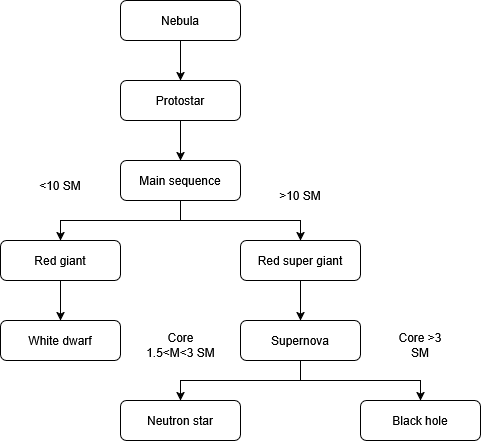
Star formation and life cycle
- Nebula
- Protostar (no fusion, but denser, so start of core)
- Main sequence (emits radiation across the EM spectrum)
- (Super) Red giant
- Supernova -> Neutron star (-> Black hole)
- White dwarf
Nebula and Protostar
A nebula is a cloud of interstellar matter composed of various elements such as hydrogen and helium. They exert gravitational force on each other, causing a dense sphere to be created from gathered matter.
This sphere is a protostar. A protostar is a small, dense sphere of interstellar matter that does not yet undergo nuclear fusion. As it gets larger, temperature and pressure increases, enabling nuclear fusion to begin. This transitions to the next phase: main sequence.
Main Sequence Star
A main sequence star is a sphere of interstellar matter that undergoes nuclear fusion. It is of a temperature where it primarily fuses hydrogen nuclei (protons) into helium nuclei.
When hydrogen runs out, the star transitions to the next phase: red (super) giant.
Red Giant
A red giant is a sphere of interstellar matter that undergoes nuclear fusion of larger elements like helium, all the way up to, and excluding, iron. This occurs due to gravitational collapse after main sequence - hydrogen is no longer being fused, so the outward pressure caused by fusion decreases, causing the star to succumb to gravitational pressure. At a low volume, the massive density causes temperature and pressure to increase to the point where nuclear fusion of these larger elements can occur.
If the main sequence star after all fuel consumption is less than 10 solar masses, it transitions into a red giant. If greater, it transitions into a red super giant (a larger red giant).
After these elements run out again, the star transitions into the next stage depending on the mass of the core of what is left.
White Dwarf
A red giant will always transition into a white dwarf. The Chandrasekhar limit states that the maximum mass for a white dwarf is 1.44 solar masses.
Supernova
The outer layers of the super red giant collapse into the core and bounce off, resulting in a blast that sends the material of these outer layers into space. The scattered material can form part of nebulae, being part of the birth of a new star.
What happens next depends on the mass of the remaining core of the super red giant.
Neutron Star
If the mass of the core is between 1.5 and 3 solar masses, it collapses into a neutron star. This is due to the gravitational pressure bringing atoms closer together, to the point where electrons collide with protons to form neutrons.
Black Hole
If the mass of the core is greater than 3 solar masses, it continues collapsing into itself, creating a black hole. This has a gravitational force so strong, even light cannot escape it.