
6.5 - Medical Imaging
Xray production
Electrons are emitted into a vacuum tube via thermionic emission. An external power supply produces a massive p.d. between the anode and cathode, causing the electrons to be rapidly accelerated in this high-voltage electric field. Then they are rapidly decelerated with collisions with a hard metal anode, causing them to lose KE (~1%) which is emitted as xrays. Rest is lost to the anode as thermal energy. Their KE is transformed into high-frequency photons of EM radiation. This radiation is called Bremsstrahlung radiation.
Xray focusing
Straight, parallel xrays are created by directing xrays to a thin window which enters a collimator that absorbs xrays that are not parallel to it. Xray energy is absorbed by tissue as it passes through the body, and how effective this absorption is depends on the attenuation coefficient mu, which is constant for different materials. The energy before entering and after exiting the body can be measured. These differences can be visualised on photographic film or a digital image to view the targeted body part.
Xray attenuation
"Exponential decay"-like formula for xray intensity loss:
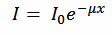
- I = Intensity
- I0 = Initial intensity
- Mu = Attenuation coefficient
- x = Distance traveled through body
Mu α z^3
... where z is the proton number of the material.
Attenuation mechanisms
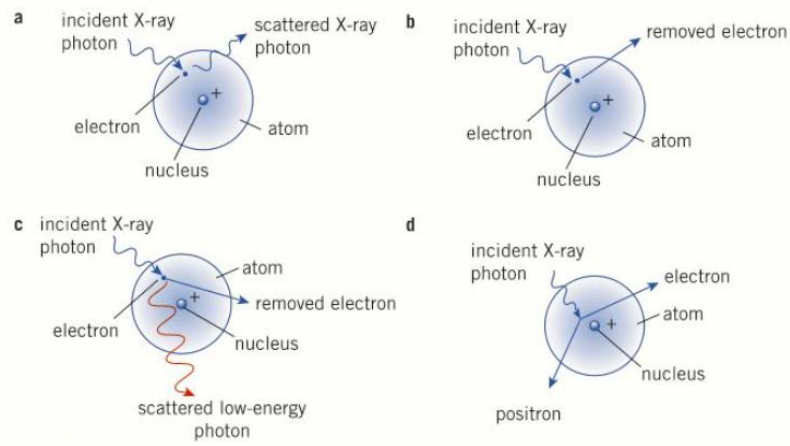
Simple Scattering (a)
Simple scattering is when xray photons reflect off of bone if they do not have sufficient energy to do more complex scattering.
Photoelectric Effect (b)
Via the photoelectric effect, xray photons are absorbed by electrons into the material, releasing photoelectrons.
Compton effect (c)
In the Compton effect, a photon interacts inelastically with an electron. The photon transfers some of its energy and momentum to the electron,electron. causingThe themphoton bothis toscattered scatterwith inless differentenergy, directions.while the electron is removed from the atom. Both energy and momentum are conserved in this interaction.
Pair Production (d)
Pair production is when an electron-positron pair is spontaneously created as the xray passes through the electric field of an atom. The required energy is about 1.02MeV, as derived below:
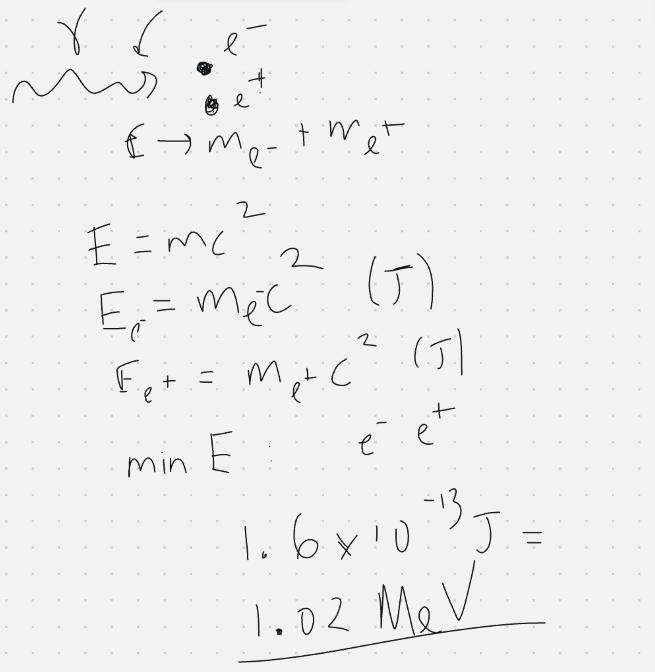
Not very applicable in medical imaging, as xrays usually don't have this much energy.
CAT Scans
Uses xrays to create a 3-dimensional image of a person's body.
The machine is a ring that the person's body passes through. It generates a fan shaped beam of xrays to take 2d slices of the person's body, which are picked up by a ring of elecronic detectors. The images are stacked on top of each other in a computer program to create the 3D product.
The resolution of the image is greater and can distinguish between different soft tissues, which 2D xrays cannot do.
However, it takes significantly longer than a 2D xray, so the patient is exposed to a higher dose of ionising radiation. About 10-30 minutes.