
4.3 - Electrical Circuits
Kirchoff's Laws
- The sum of currents entering a junction in a circuit is equal to the sum of currents exiting this junction. This ensures conservation of charge.
- The sum of emfs in a loop of a circuit is equal to the sum of potential differences of all components in the loop. This ensures conservation of energy.
Resistance Sums
|
Energy must be conserved, so the sum of potential differences of the components must be equal to the pd across all relevant components (which can be emf). As per V = IR, we can express this as:
We can divide both sides by I to get:
|
|
Again, energy must be conserved. Total circuit current can be expressed using Kirchoff's 1st law as:
However, as per Kirchoff's 2nd law, voltage on each branch is equal:
Taking the first equation, as I=V/R:
Dividing through by V gives us:
|






Potential Dividers
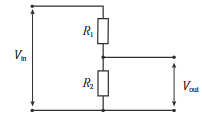
Potential difference is split across resistors from the total voltage of a loop in a ratio based on resistance of each component. This enables the delivery of electrical power to multiple parts of a circuit in differing ratios.
Internal resistance
Cells aren't perfect - they still have a small amount of resistance themselves due to . In manufacturing, this internal resistance is made to be as low as possible, but cannot reach zero.