
4.1 - Charge and Current
Key info and definitions
Electric Circuit Components
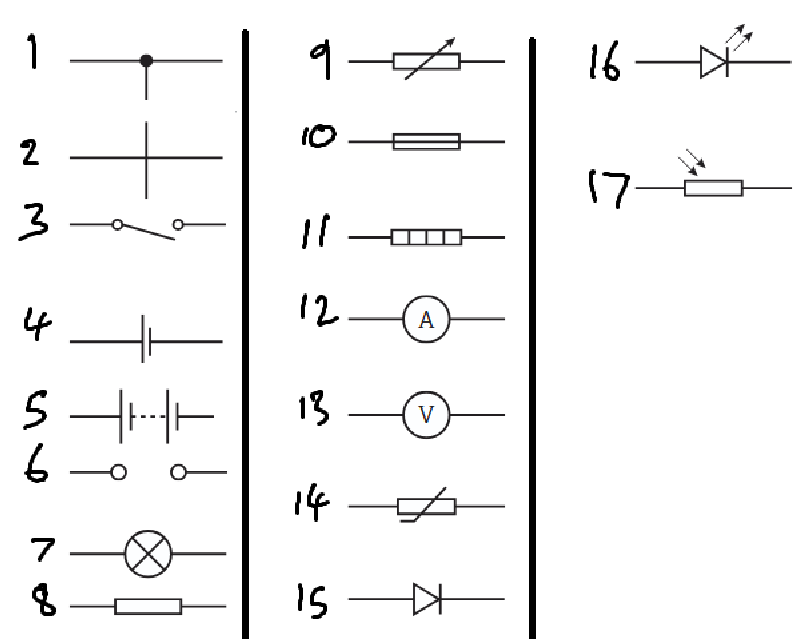
- Junction of conductors: Allows current to split; resistance is typically low but increases with temperature.
- Conductors crossing (no connection): Allows current to flow across a circuit without connecting to the crossing wire; resistance is typically low.
- Switch: Turns current on and off; resistance is low when closed and very high (due to an air gap) when open.
- Cell: Provides a source of energy or e.m.f. (electromotive force); resistance is low or negligible.
- Battery: A combination of two or more cells; internal resistance increases as more cells are added in series.
- Terminals: Provides a connection point for a source of energy; resistance is low.
- Lamp: Transfers electrical energy into light; resistance increases as the current increases.
- Fixed resistor: Controls the amount of current; resistance is fixed and determined by its material (often semiconductors like silicon).
- Variable resistor: Controls current flow manually; resistance changes based on the slider or dial setting.
- Fuse: A safety device that melts if current is too high; resistance is typically low and depends on the wire's dimensions and material.
- Heater: Transfers electrical energy into thermal energy; resistance is typically high.
- Ammeter: Measures the electrical current in a circuit; resistance is very low.
- Voltmeter: Measures the potential difference (e.m.f.) across a component; resistance is very high.
- Thermistor: Responds to environmental temperature; resistance changes in response to the temperature of the surroundings.
- Diode: Restricts current to one direction; resistance is low in forward bias and very high in reverse bias.
- Light-emitting diode (LED): Allows current in one direction and emits light; resistance is low in forward bias and high in reverse bias.
- Light-dependent resistor (LDR): Changes current based on light levels; resistance decreases as light intensity increases.
Electric Current and Charge
Current is the rate of flow of electrical charge.

... where Q is charge and t is time.
Atoms become charged when they gain or lose electrons.
Conventional current travels in the direction of flow of positive charge - i.e. the opposite of electron flow.
Kirchoff's Laws
- The sum of electrical current into a junction is equal to the sum of electrical current out of a junction. Ensures conservation of charge, as flow of charge into a junction point = flow of charge out of the junction point.
- In a closed loop of a circuit, the sum of potential differences is equal to the sum of emfs. Ensures conservation of energy, as energy into the circuit = energy out of the circuit.
Electron Drift Velocity
When conducting electricity, electrons move slowly through the wire at a drift velocity v.

... where I is current, n is number density of the wire's conducting material, A is the cross sectional area of the wire, v is the electron drift velocity, and e is the elementary charge, 1.6e-19C.
The larger the value of n, the greater the conductivity of the metal.