Section 4 - Exchanging Data
Relational Databases and Normalisation
Core Info and Definitions
A relational database contains tables, making use of relations between them to store data with minimal data redundancy.
Normalisation is a process used to come up with the best possible database design by following a set of formal rules. It ensures:
- No data is unnecessarily duplicated.
- Data is consistent throughout the database
Transaction Processing and ACID
ACID
| Atomicity |
A rule that requires a transaction to be fully completed or not started at all. E.g. Rolling back changes if a system crashes mid-payment. |
| Consistency |
Any changes to the database must retain its overall state/integrity. E.g. if an attempt is made to add students beyond maximum capacity, it fails. |
| Isolation |
Each transaction is executed and committed to the database in isolation. E.g. record locking. |
| Durability |
Once a transaction has been committed, it must be processed until completion. If it requires multiple actions, all of them must be completed before committing. I.e. saving changes. |
Transaction Processing
Measures need to be taken in order to ensure that multiple users using a database does not harm referential integrity.
Record locking prevents simultaneous access to a record to prevent updates from being lost or inconsistencies in data arising.
However, deadlock can occur. This is when a committed process depends on data from a locked record, which is locked because of a running process that depends on another record locked by the former process. This can be solved with one of the following:
| Serialisation | Ensures transactions do not overlap in time, so they cannot interfere with each other or lead to lost updates. A transaction cannot start until the previous one is complete. This is implemented with timestamp ordering. |
| Timestamp ordering |
When a transaction starts, it is assigned a timestamp. If two processes are simultaneously affecting the same record/table, the process with the earlier timestamp is executed first. Each object in a database has a read timestamp and a write timestamp to mark when it was last read from or written to.
If on write the object's read timestamp does not match the process', it knows that another process is operating on the object. |
| Commitment ordering | Ensures that transactions are not lost when two or more users are trying to access the same object. Transactions are ordered in terms of their dependencies on each other as well as the time they were initiated. Helps prevent deadlock. |
| Redundancy | Having multiple identical systems all manipulated at the same time. If one system goes down, another can instantly start being used to replace it until it comes back online. |
First Normal Form
- A table contains unique records.
- Data in fields is atomic - i.e. no grouped data in fields, e.g. grades for three separate subject should be in three separate records, not one.
Second Normal Form
- The table is in first normal form.
- There are no partial dependencies - i.e. a field depends on only part of the primary key (seen in composite keys).
Third Normal Form
- The table is in second normal form.
- There are no transitive dependencies - i.e. fields ONLY depend on the primary key, not any other field.
Database concepts
Modelling
Core info and definitions
When creating a database, you must identify the entities. An entity is a "category of object, person, event or thing of interest to an organisation about which data to be recorded". These entities are presented as tables. Column headings are fields/attributes, and each row is a record.
Entities are described in written form as:
EntityName(Attr1, Attr2, Attr3, ...)
Referential integrity ensures that a foreign key in one table always refers to the primary key of another table. This prevents orphan records, maintains data consistency across tables, and enforces logical relationships between entities.
Keys
A primary key is a unique identifier for each row.
A composite primary key is a primary key made up of two fields. These two fields do not need to be unique on their own, but when combined, they must be unique.
A secondary key is another field of a table that is indexed and used to search it faster - e.g. searching by surname. They do not need to be unique for each record. However, the indexing table uses up extra storage space.
A foreign key is a field that contains the primary key of another table. These are used to draw relationships between tables.
Entity Relationship Diagrams
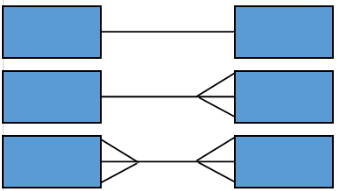
One to one is when one record of a table is related to exactly one record of another table.
One to many (or many to one if reversed) is when one record of a table can be related to multiple records of another table.
Many to many is when many records of a table can be related to many records of another table. This cannot be achieved without significant redundancy normally, so an intermediate linking table with composite primary keys from both tables is used to minimise data redundancy.